
 8.6 out of 10 based on 80898 reviews








.svg)
.svg)
.svg)
.svg)
.svg)
.svg)



 Menu
Menu
-
 Vaporshop
All Categories
Vaporshop
Vaporshop
All Categories
Vaporshop
- Top 10 Vaporizers
- Spare Parts & Accessories
- AirVape XS GO (2021)
- Arizer Air MAX
- Arizer Extreme Q
- Arizer Solo 2
- Arizer V-Tower
- Arizer XQ2
- Boundless CFC 2.0 Vaporizer
- Boundless CFX
- Boundless TERA (V3)
- CRAFTY+
- DaVinci IQC
- Dr. Dabber Boost EVO
- DynaVap VapCap "M" PLUS 2023
- DynaVap VonG (i) Titanium
- Flowermate Aura
- Flowermate Cap Pro
- Flowermate Slick
- Flowermate V5.0S Pro
- G Pen Elite II
- G Pen Micro+
- G Pen Roam
- Hyer Big-E Rig
- MIGHTY+
- PAX Mini
- PAX Plus
- PLENTY
- Puffco Peak Smart Rig
- Puffco Plus
- Storm Vaporizer
- The Proxy (Puffco)
- VOLCANO CLASSIC
- VOLCANO HYBRID
- Vapman 2.0
- Vapman Click
-
 Smartshop
All Categories
Smartshop
Smartshop
All Categories
Smartshop
- Top 10 Smartshop
- Zamnesia Gift Cards
- After Party
- Aphrodisiacs
- Aromatherapy
- Blue Lotus
- Capsule Machines
- Crystals, Gemstones & Minerals
- Dream Herbs
- Drug Tests
- Extracts
- Happy Caps
- Herbal Tea
- Herbs & Seeds
- Incense
- Kanna
- Kratom
- LSA Seeds
- Mescaline Cacti
- Microdosing
- Nootropics
- Relaxing
- Salvia divinorum
- Smart Seeds
- Stimulants
- Supplements
- Tinctures
- Vape Herbs
-
 TRIBE
All CategoriesTRIBE
TRIBE
All CategoriesTRIBE
- My Membership
- Spend Gift Points
- TRIBE Sale
- Exclusive products
- Earn Extra Gift Points
- Early Access
- Refer a Friend
- Information
 Mushroom Dosage Calculator


 Help
Help United States
The European Cannabis Culture Report 2025




The European Cannabis Culture Report 2025 analyses 6,046,287 cannabis seeds purchased across 25 European countries. Based on real retail transaction data, it reveals how growers actually buy seeds, strains, and genetics across Europe.
Inside the 2025 Report: Highlighting Europe’s Shifting Landscape
The European Cannabis Culture Report 2025 is one of the first continent-wide analyses of cannabis seed purchasing behaviour built entirely on real transaction data rather than surveys or self-reported information.
The dataset covers 6,046,287 individual seeds sold across roughly 1.9 million seed packages between January 2024 and December 2025. The analysis spans 25 European countries and more than 500 cannabis strains. The data was aggregated and anonymised from multiple European seed retailers, including Zamnesia.
Because the research examines what people actually purchase, it provides a clearer view of cannabis culture than opinion surveys. The data reveals how preferences differ across Europe, from strain genetics and growing styles to consumer loyalty and seasonal buying patterns.
The research period also captures a pivotal moment for the European cannabis landscape. Germany legalised personal cannabis cultivation in April 2024, creating the largest home growing market in Europe and triggering measurable changes in purchasing behaviour across neighbouring countries.
Key Dataset Statistics
| Metric | Value |
| Total seeds analysed | 6,046,287 |
| Seed packages | 1.9 million |
| Countries covered | 25 |
| Unique strains | 500+ |
| Research period | January 2024 – December 2025 |
| Data source | Aggregated transaction data from European seed retailers including Zamnesia |
Key Discoveries From the Data
1. Germany dominates the European seed market
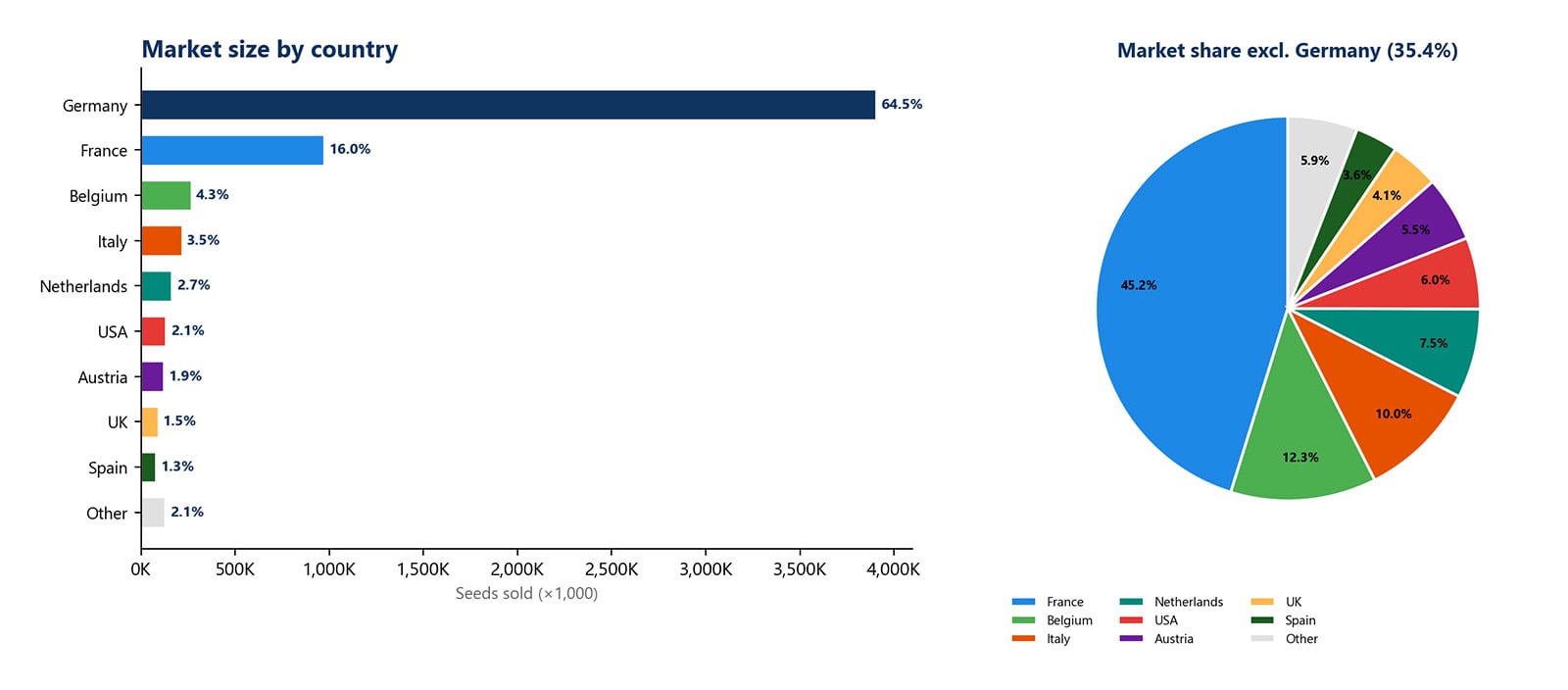
Germany accounts for 64.6% of all cannabis seeds purchased in Europe in the dataset. During the weeks surrounding legalisation in March and April 2024, Germany represented 73.4% of all European seed orders as consumers prepared for legal home growing. Following the initial surge, purchasing activity in Germany declined by 18.4% as demand shifted towards local retail channels and cultivation clubs.
2. The legalisation spillover effect
German legalisation influenced neighbouring markets across the continent. All eight countries bordering Germany experienced growth ranging from 20% to 117% during the research period.
This pattern suggests that cannabis policy changes in one country can drive awareness and demand in surrounding markets.
3. The autoflower myth does not hold up in the data
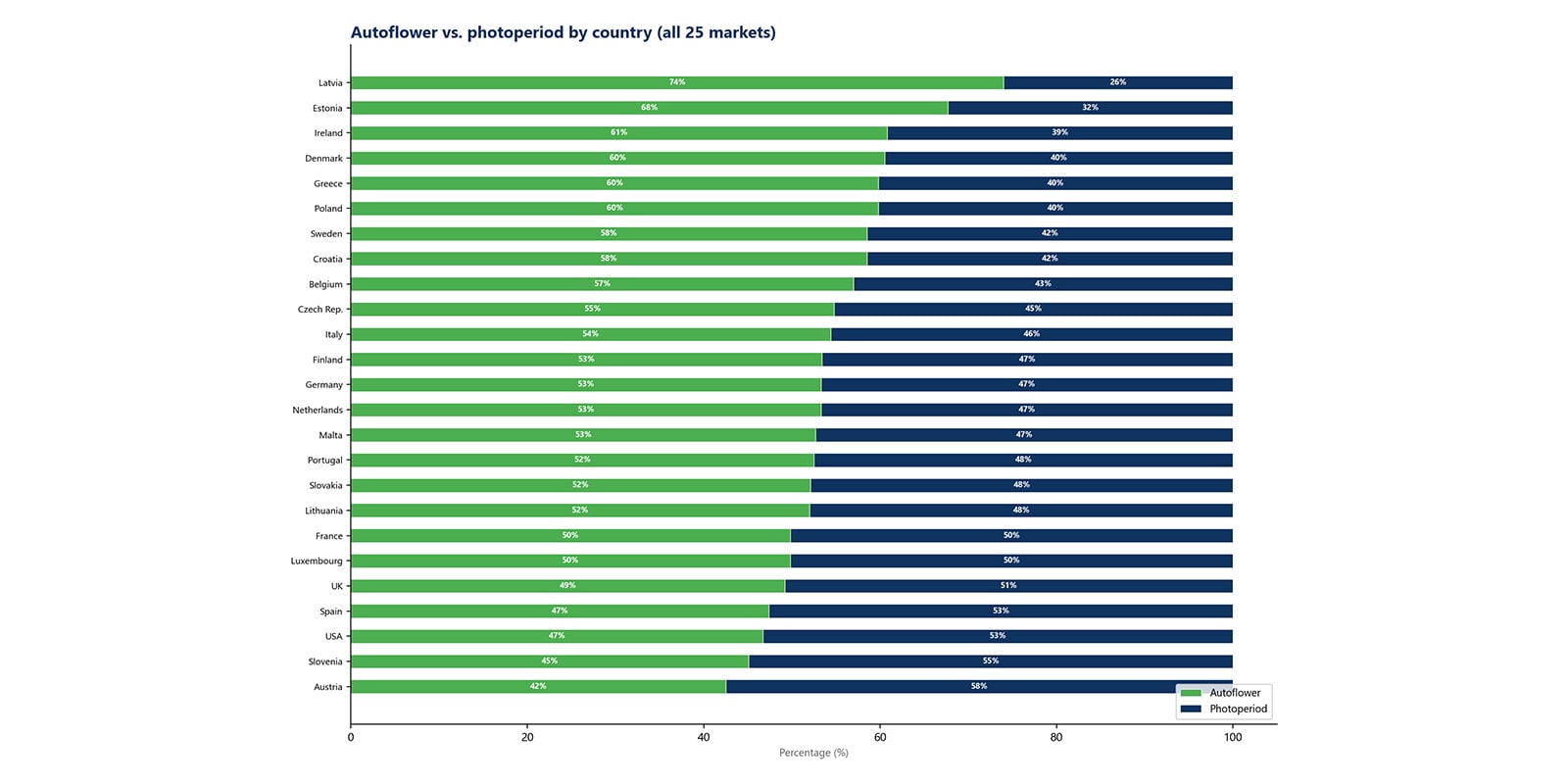
Autoflower cannabis seeds are often described as beginner genetics. The data suggests the distinction is largely outdated.
Autoflowers were purchased by 59.1% of first-time buyers and by 56.4% of experienced customers with five or more orders. The difference is only 2.7 percentage points, indicating similar adoption among both groups.
4. Three consumption cultures across Europe
Purchasing patterns for consumption accessories reveal three broad cannabis cultures across Europe.
Southern and Benelux countries such as Italy, the Netherlands, and Belgium remain strongly associated with joint culture. Germany, Austria, and Spain show higher spending on vaporisers. The United Kingdom stands out with a stronger glass and pipe culture than other European markets.
5. Northern Europe has the most experienced growers
Finland shows the highest proportion of returning customers at 44.3% and the highest experience score in the dataset at 65.9. The score combines several indicators including repeat purchases, grow supply buying, and seed selection behaviour.
This suggests that smaller markets with restrictive environments can develop highly knowledgeable grower communities.
6. CBD seeds are declining
CBD-focused cannabis genetics are declining in the dataset. CBD seed purchases fell by 40.2% year over year.
THC-dominant varieties represent 97.9% of all seeds purchased in the dataset, indicating that potency-focused genetics remain the norm in European seed buying patterns.
7. Plant height reveals cultivation styles
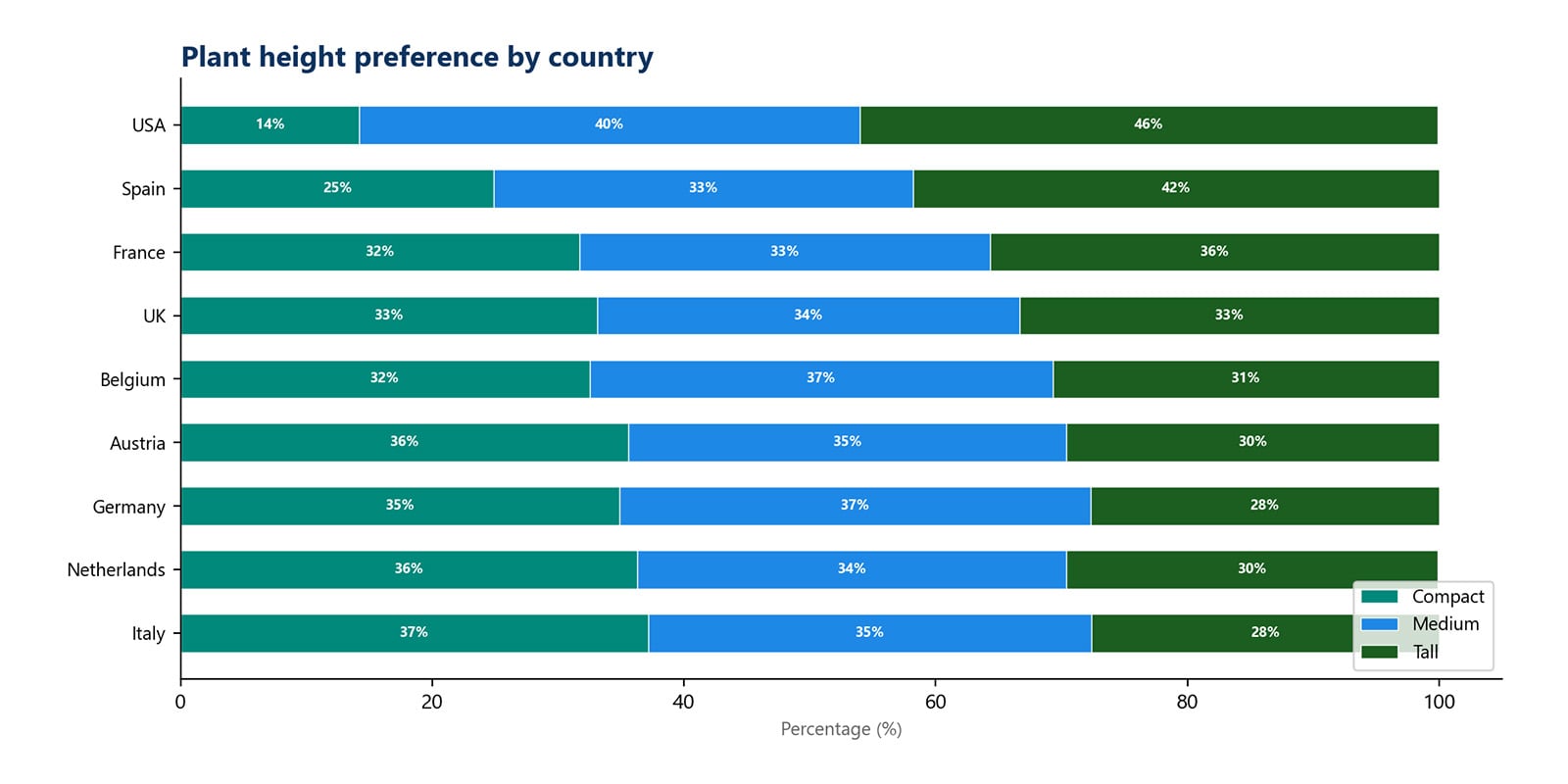
Plant height preferences provide a useful indicator of growing environments. Italy shows the highest share of compact plants at 37.2%, suggesting a stronger focus on indoor cultivation.
Spain shows the highest share of tall plants at 41.8%, consistent with outdoor cultivation in Mediterranean climates.
8. The Netherlands paradox
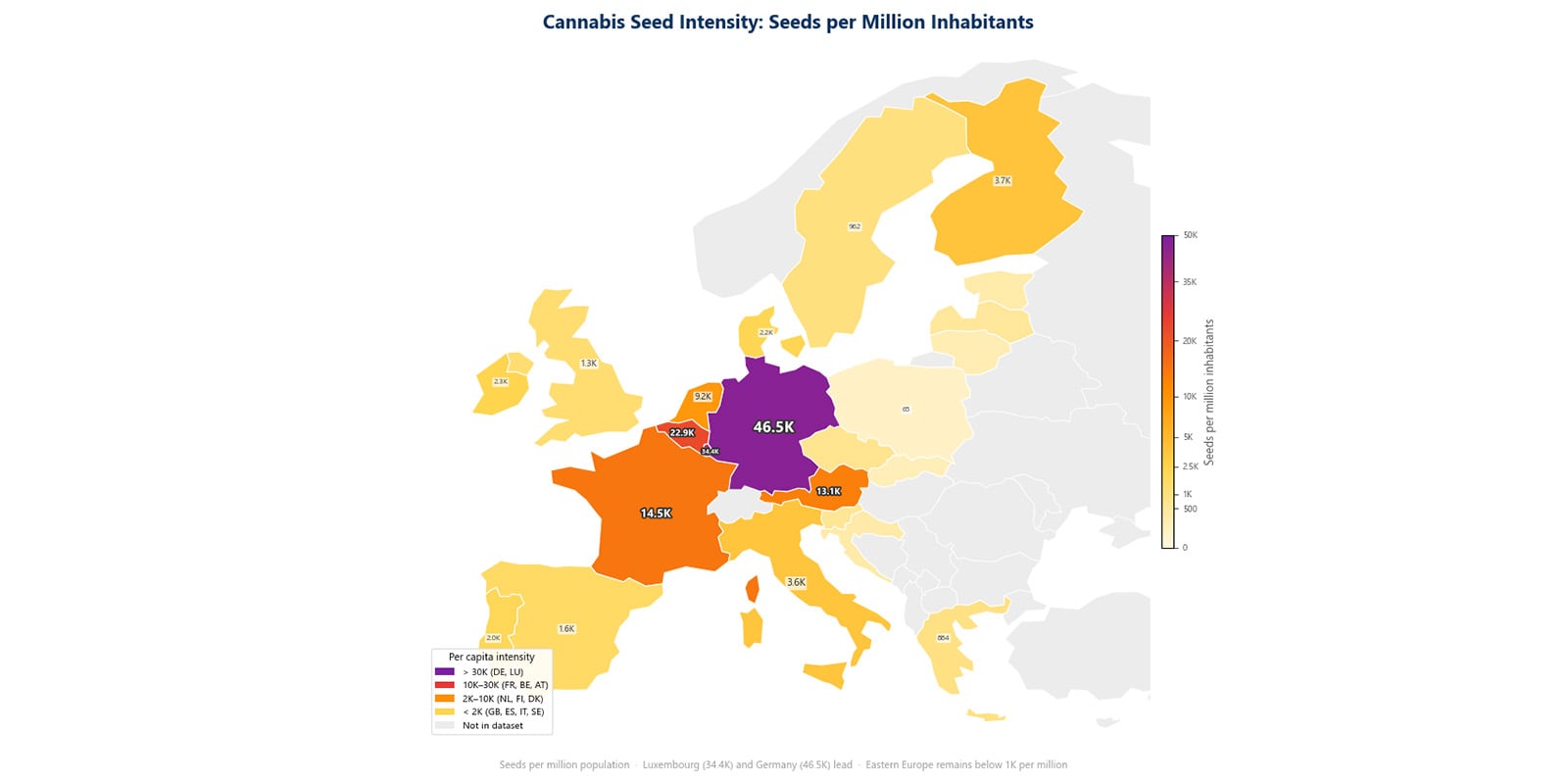
Despite its global reputation for cannabis culture, the Netherlands shows relatively low seed purchasing intensity with 9,204 seeds per million inhabitants.
At the same time, Dutch customers show the highest cultivation-to-seed investment ratio at 19.3%, indicating that growers who do cultivate tend to invest heavily in equipment and supplies.
9. American genetics entering the European market
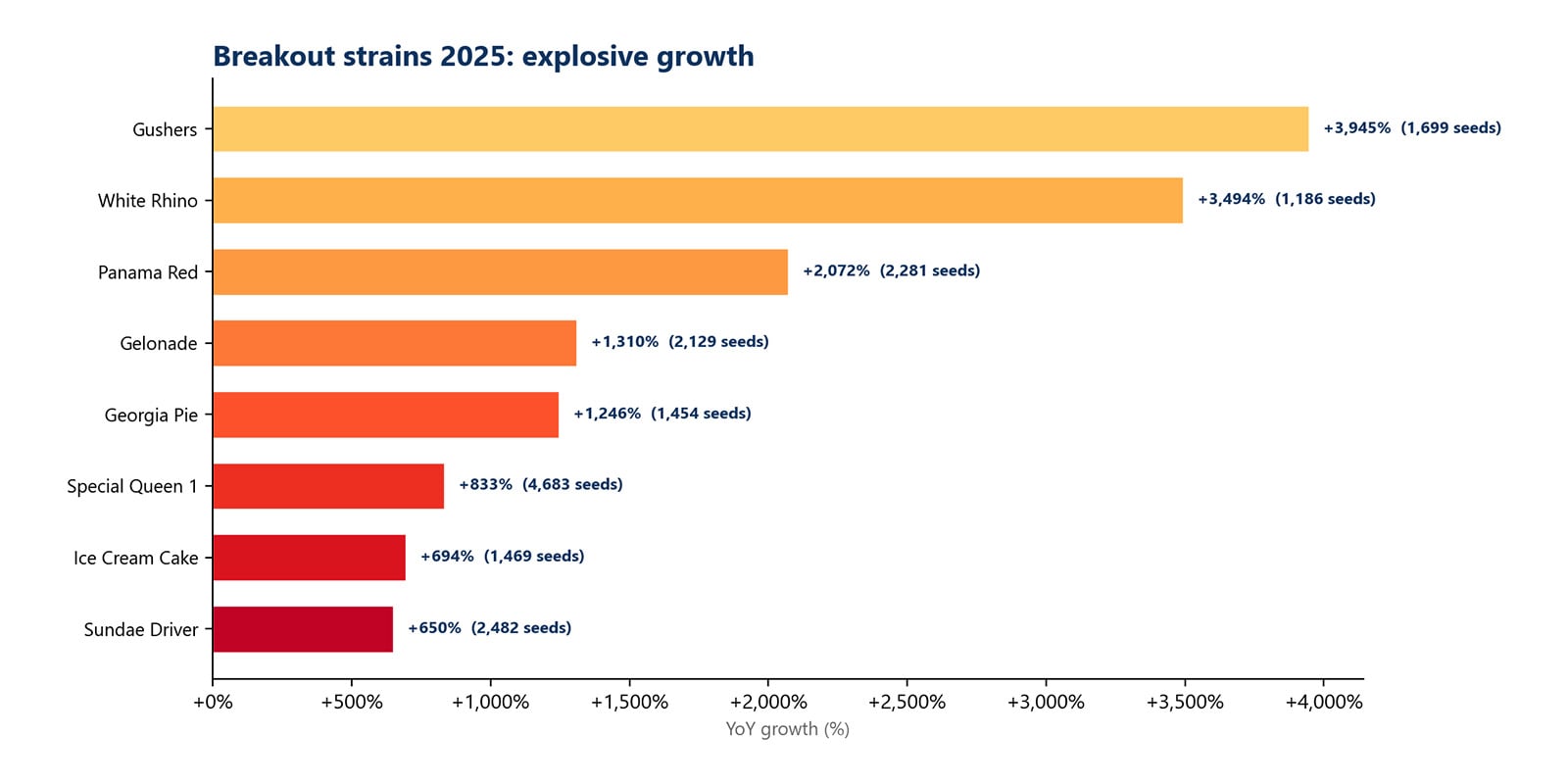
Modern flavour-oriented genetics are replacing many classic strains in European seed purchases.
Genetic families linked to Gelato, Cake, Sherbet, and Cookies dominate growth trends, while earlier generation strains such as Amnesia Haze, Cheese, and Blueberry show significant declines.
10. Regional differences in order size
Order sizes vary significantly across Europe. Austria averages 4.4 seeds per order and Germany 4.2, the largest averages in the dataset.
Spain and the United Kingdom show the smallest order sizes at 2.2 and 2.4 seeds per order respectively.
11. F1 hybrid genetics are expanding rapidly
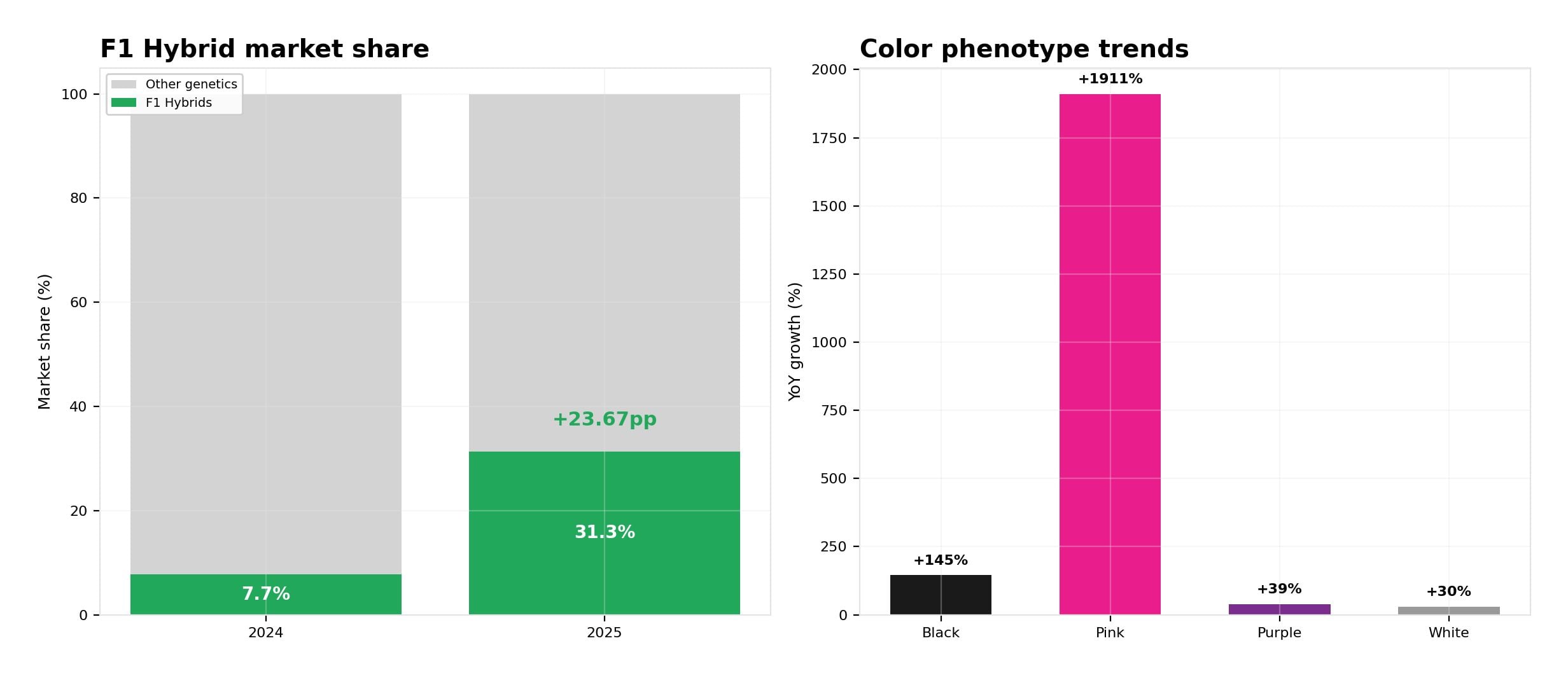
One of the most significant genetic shifts in the dataset is the rapid expansion of F1 hybrids. Their market share increased from 7.66% to 31.33% during the research period.
This represents a 226.6% increase and reflects growing interest in stabilised hybrid genetics.
12. Scandinavia is the fastest-growing region
Northern Europe shows the fastest growth rates in the dataset. Denmark increased by 55% and Finland by 45% during the research period.
Although these markets are smaller in absolute size, they show strong loyalty and high levels of grower engagement.
13. Three cultivation archetypes across Europe
The data suggests three broad grower profiles across European markets.
- Nutrient-focused growers in Germany and France allocate more than half of cultivation spending to fertilisers.
- Quality-output growers in the Netherlands, Finland, and Spain invest heavily in post-harvest processing.
- Infrastructure-heavy growers in the UK and Italy spend more on grow tents and indoor equipment.
Download the Full Report
.jpg "Download the Full Report")
The complete European Cannabis Culture Report includes more than fifty pages of data visualisations, country comparisons, and detailed strain analysis.
The full report can be downloaded to explore the complete dataset and deeper insights into cannabis seed purchasing patterns across Europe.
Methodology
This research is based on anonymised transaction data from multiple European cannabis seed retailers including Zamnesia.
- Research period: January 2024 to December 2025
- Total seeds analysed: 6,046,287
- Seed packages: approximately 1.9 million
- Countries covered: 25
- Unique strains: more than 500
The dataset reflects online purchases only. Physical retail activity is not included and purchasing behaviour may differ in offline channels.
Smaller markets may have limited sample sizes. Data was aggregated across retailers and individual retailer market share is not disclosed. B2B and test orders were excluded from the analysis.